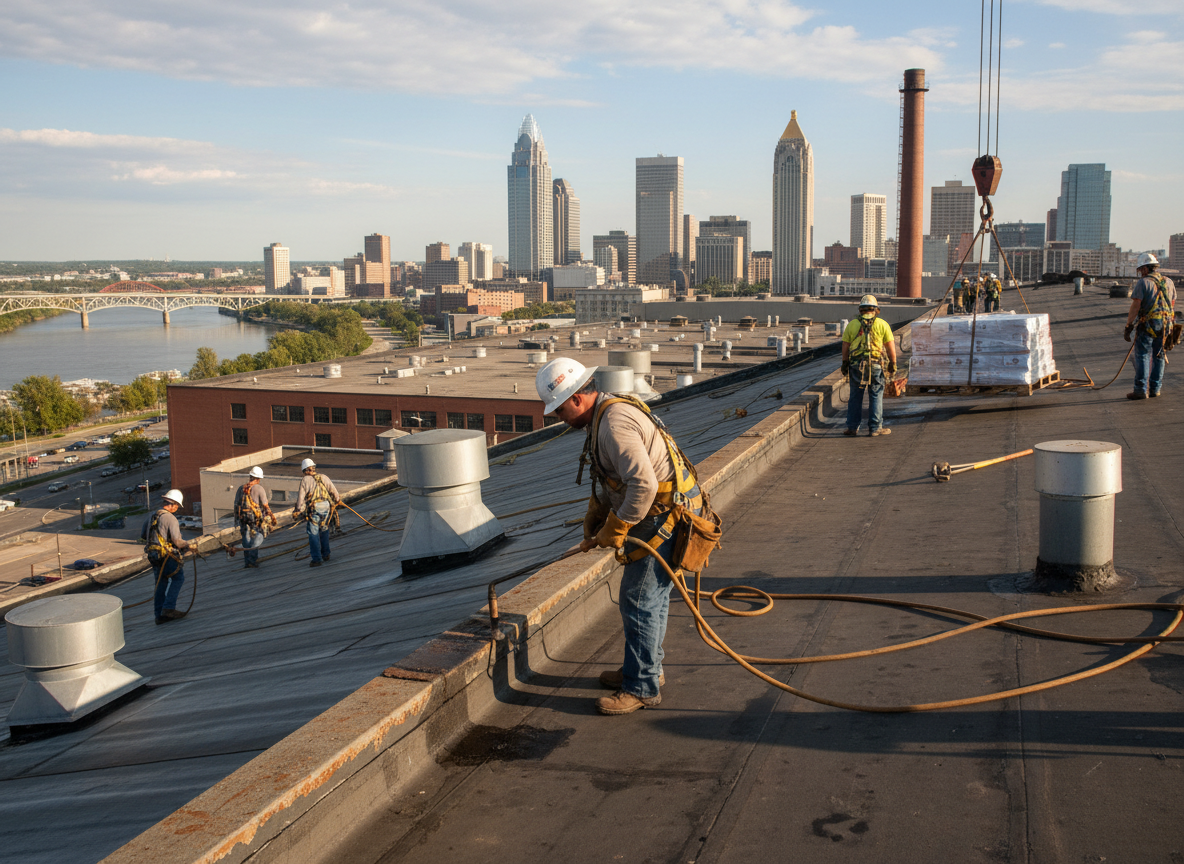
Cincinnati's humid subtropical climate brings hot summers that cause significant thermal expansion on industrial roofs, especially on older warehouse structures in Norwood and Newport. These conditions accelerate membrane fatigue and seam failures on flat roof systems common to Hamilton County industrial buildings. Proper ventilation and reflective coatings become essential to manage heat buildup and prevent blistering during peak summer months.
Many industrial sites near Downtown Cincinnati and Over-the-Rhine sit on buildings constructed before modern drainage standards, leading to ponding water issues that compound with heavy seasonal rains. Contractors must evaluate existing substrate conditions carefully, often replacing deteriorated insulation while maintaining structural integrity on metal deck roofs typical in the area. Local terrain variations around Mount Adams slopes can also affect runoff patterns on adjacent industrial properties.
Code compliance in Hamilton County requires attention to wind uplift ratings and fire resistance for industrial applications, particularly on facilities near the Great American Ball Park and Findlay Market zones with higher occupancy loads. Material choices like reinforced TPO or EPDM systems perform better against Cincinnati's humidity-driven moisture intrusion than traditional built-up roofs, but installation demands precise seam welding to avoid callbacks during summer storms.
Edge cases arise when retrofitting roofs on aging Hyde Park industrial conversions where original skylights and HVAC penetrations create leak points under thermal stress. Experienced crews account for these by installing custom curbs and flashings designed for the region's temperature swings rather than generic solutions.
Technician insight
In Cincinnati, the thing that catches most people out with industrial roofing contractors is underestimating how our hot humid summers drive constant expansion on older flat roofs in Norwood and Newport, turning small seam gaps into major leaks if the original insulation wasn't upgraded.
Warehouse Roof Failure Near Norwood
A manufacturing facility reported recurring leaks after summer storms. Inspection revealed deteriorated seams on the existing EPDM from years of thermal cycling. We removed failed sections, added new insulation for better heat resistance, and installed reinforced TPO with updated flashings around all penetrations. The roof now handles Cincinnati humidity without ponding or seam separation.
How it works
- 1
Site Assessment
Evaluate roof condition, drainage, and existing materials on the industrial structure while noting Cincinnati-specific factors like summer heat exposure.
- 2
Material Selection
Recommend systems such as TPO or EPDM suited to humid subtropical conditions and the building's age in neighborhoods like Norwood.
- 3
Preparation and Repair
Address substrate issues, improve insulation, and correct ponding areas common on older Hamilton County industrial roofs.
- 4
Installation
Apply the chosen membrane with reinforced seams and flashings designed for local thermal expansion and wind loads.
- 5
Final Inspection
Test for leaks and verify compliance before handing over the completed industrial roof project.
Pricing
Upfront quotes provided after on-site assessment; costs vary by roof size, condition, and material choice.